Showing posts with label holy. Show all posts

Sunday, 20 April 2025

It''s That Simple

It was a cool morning, although the first rays of sun appearing were a sign it wouldn’t remain that way. I can remember thinking – wondering I suppose – where I might be walking to without the generosity of Joseph, the Arimathean – for a member of the Sanhedrin it was a dangerous act to provide us with a tomb, but who knows where I would have been heading if he hadn’t.

The first thing I felt was confusion – as soon as I entered the garden, I knew something wasn’t right – you get that feeling sometimes, don’t you? That first hint, the slightest perception, of things not being as they should be.

After the confusion, or maybe alongside it, was the fear, seeing that huge boulder moved from the entrance – something that took a dozen of us to put in place – I knew for certain then – thought I knew – that our Lord’s body had been taken, stolen away, only God knows for what end.

I was too churned up to look inside, terrified of what I might see, without knowing what any of us could do I ran back to where we were lodged (praise God for our protectors) and I saw Simon Peter and John speaking by the door.

I must have looked like a wild woman, completely incoherent, I no idea what I might say to them.
Peter asked “Mary, what is it, what’s happened?!”
Barely able to speak, something just burbled out between the tears. John of course wrote it down later:
‘They have taken the Lord out of the tomb, and we do not know where they have laid him.’ He reports I exclaimed, between the sobs.

Once they’d taken this in, they looked at each other with the same panicked expression that must have been on my face, touched my arm, and ran back in the direction I’d come from.

At this point I could barely catch my breath, but I turned and followed them back, my chest and calves burning, unable to keep up with them at all. I could see that John had got ahead of Peter, but when I eventually caught up, I could see John just standing at the entrance, finding himself unable to enter.

For once I was thankful for Peter’s impulsive nature, he overcame our collective fears to enter the tomb, whilst John and I seemed rooted to the spot, although in all honestly, I was so exhausted from running there and back that I’d sunk down to ground by this point, my breathing loud and laboured as my body recovered.

Peter emerged so quietly, a look of incomprehension on his face. He told us how the linen wrappings were just lying there, and that the cloth that had been on Jesus’ head was separate, not lying with the linen wrappings but rolled up in a place by itself.

This is where John had to see for himself, also entering the tomb, seeing that all was as Peter had said. Now, you must understand that despite everything we’d experienced with the teacher, everything we’d been told and witnessed, none of us yet understand the scripture that told us He must rise from the dead.

With no understanding of what this meant or where Jesus’ body might be, the men left, returning to the house.

And I sat, and I wept. I wept from fear, I wept from confusion and frustration, but mostly I wept from grief, and from love. I wept because I was confronted with the reality of Jesus’ death, and now I couldn’t even mourn his body, or honour him with our traditions.

Between my sobs, I felt compelled to look for myself, to see what the men had seen, to know with my own eyes that it was true. I heaved my exhausted body from the ground and stooped to look inside the tomb. But I didn’t see what Peter and John had seen.

I’ll probably sound like a mad woman – probably this whole story makes me sound like a mad woman – but I don’t care, I saw what I saw, and I believe what I saw.

When I looked inside the tomb, I saw what I can only describe as two angels in white, sitting where the body of Jesus had been lying, one at the head and the other at the feet. They must have been angels, there were certainly not of the earth. And they spoke to me, or at least I heard the words inside my head, it’s hard to explain when you’ve encountered angels!

They asked me: ‘Woman, why are you weeping?’ and I’m sure I repeated the words John tells me I said to him: ‘They have taken away my Lord, and I do not know where they have laid him.’

I often wonder what they might have replied if I hadn’t at that point become aware of someone standing behind me. Not knowing if it was of the men returned, another disciple come to grieve or a soldier alerted by our comings and goings, I turned sharply to see the gardener in front of me, or the person I presumed was the gardener by his appearance.

He repeated the words of the angels – making me think for a moment I’d imagined them and this man had been saying the words all along. ‘Woman, why are you weeping?’ – a ridiculous question to a woman visiting a tomb! Before I could answer he questioned ‘For whom are you looking?’

Beginning to retain some semblance of rational thought – despite all I’d experienced before the sun was even fully risen – it struck me that this man may have seen something, if he tended to this place, he would maybe know who had come and gone, or maybe even he’d been paid or instructed to move Jesus by the authorities?

I took a breath, ‘Sir, if you have carried him away, tell me where you have laid him, and I will take him away.’ I looked into his eyes, silently pleading.

His response was just one word, ‘Mary’. And in an instant I knew. He said my name, as He had done so many times, but this time I felt it’s resonance through my entire body. With one word my eyes were opened, and I saw Jesus stood before me, and I knew more than ever that my soul and body would for the rest of my life be a living sacrifice to him.

“Teacher!” I exclaimed and dropped to my knees. I needed to touch him, to kiss his feet, to anoint them with my tears which were now tears of joy, but he stepped back from my reach.

“Do not hold on to me Mary, because I have not yet ascended to the Father. But go to my brothers and say to them, “I am ascending to my Father and your Father, to my God and your God.”

And then, I don’t know if he was gone or if I turned, but I was running once more back to the town and to the others, still so confused but with a surety of what I needed to do for our Lord, our Jesus, our rabbi – our Christ, The Messiah! Oh my God, my God! It was all true. He is my God.

I’ll never know why He chose me as the first witness – as the first to share the news and make sense of his teachings. In three days he had risen again, he told us so many times this would be so but until this moment we had never truly understood.

I banged on the door of our lodging house – I didn’t care if I was seen or heard, not anymore. I told them quite simply “I have seen the Lord”, then recounted all these things I have told you here.

They heard my testimony, and they believed, and that belief spread. We told people the good news – that we have a God who knows us, who came to live alongside us, who has shared our joys and our griefs, who has shared our food, who knows what it is to strive - who knows no one is holy enough to obey all the laws of moses and so gives us the most simple instruction; to love.

To love God and each other. It’s that simple. Our God is the God of love.
Amen
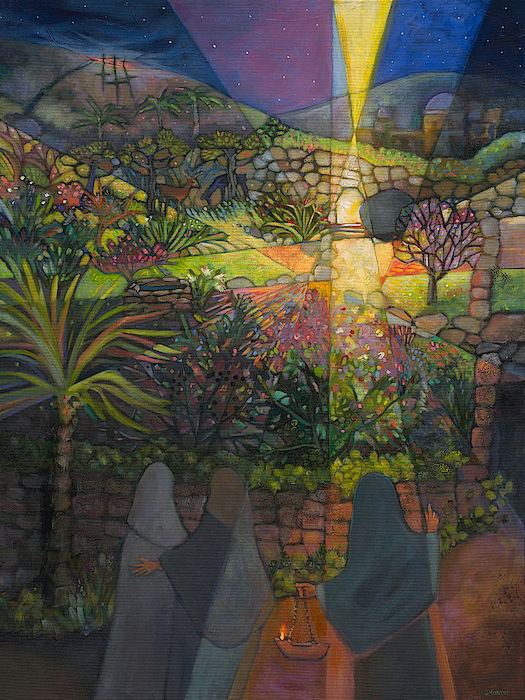
Sermon based upon John 20:1-18
20Early on the first day of the week, while it was still dark, Mary Magdalene came to the tomb and saw that the stone had been removed from the tomb. 2So she ran and went to Simon Peter and the other disciple, the one whom Jesus loved, and said to them, ‘They have taken the Lord out of the tomb, and we do not know where they have laid him.’ 3Then Peter and the other disciple set out and went towards the tomb. 4The two were running together, but the other disciple outran Peter and reached the tomb first. 5He bent down to look in and saw the linen wrappings lying there, but he did not go in. 6Then Simon Peter came, following him, and went into the tomb. He saw the linen wrappings lying there, 7and the cloth that had been on Jesus’ head, not lying with the linen wrappings but rolled up in a place by itself. 8Then the other disciple, who reached the tomb first, also went in, and he saw and believed; 9for as yet they did not understand the scripture, that he must rise from the dead. 10Then the disciples returned to their homes.
11 But Mary stood weeping outside the tomb. As she wept, she bent over to look a into the tomb; 12and she saw two angels in white, sitting where the body of Jesus had been lying, one at the head and the other at the feet. 13They said to her, ‘Woman, why are you weeping?’ She said to them, ‘They have taken away my Lord, and I do not know where they have laid him.’ 14When she had said this, she turned round and saw Jesus standing there, but she did not know that it was Jesus. 15Jesus said to her, ‘Woman, why are you weeping? For whom are you looking?’ Supposing him to be the gardener, she said to him, ‘Sir, if you have carried him away, tell me where you have laid him, and I will take him away.’ 16Jesus said to her, ‘Mary!’ She turned and said to him in Hebrew, b ‘Rabbouni!’ (which means Teacher). 17Jesus said to her, ‘Do not hold on to me, because I have not yet ascended to the Father. But go to my brothers and say to them, “I am ascending to my Father and your Father, to my God and your God.” ’ 18Mary Magdalene went and announced to the disciples, ‘I have seen the Lord’; and she told them that he had said these things to her.

Sunday, 28 January 2024

Becoming Ourselves

Won't get the chance to preach this today as I'm isolating at home with Covid, but as it was written I thought I'd share it.

Well, today’s readings take us on quite a journey, and perhaps take us to places we’re not entirely comfortable with. 

In Deuteronomy we have a prophet promised, a text we might interpret as referring to Jesus, and then some uncomfortable reading about the fate of false-prophets. 

From Revelation we have mystical, mysterious and mythical verses. John’s writing in this book can never be taken at face value, but again our interpretation would be that this poetic birth refers to Jesus.

And then in the Gospel we have Jesus beginning his ministry, he’s been baptised, spent his time in the wilderness and now he’s ready to go public. Mark’s account of this, as we heard this morning, includes a demonic possession and exorcism, and whilst our contemporary interpretations with our modern, scientific minds would try and interpret demonic possession as something more worldly, we do a disservice to the gospel when we don’t acknowledge that the world we’re shown here is one that does believe in demons, there’s 4 exorcisms in Mark even though it's the shortest of the gospels. This probably leaves us, like those present in the synagogue, asking “what is this”.

But I’m not, you’ll hopefully be glad to hear, planning on analysing the nature of biblical possession this morning. I must admit when I read the texts for today I was thinking, like the synagogue congregation, “what is this” and more pressingly, what does this say to us today, on this final Sunday of Epiphany as we come to the end of the Christmas season? 

The mystery and joy of the Incarnation and of the Christmas story are intimately woven through these readings. We have Moses promising a prophet from amongst God’s own people, our very human Messiah, but then we have John’s poetic, mystical retelling of God being born of a human woman, a child who escapes evil and returns to God.

The Gospel reading brings these two things together and shows us the reality of what the incarnation means as Jesus stands up to publicly declare his ministry has begun, and is immediately confronted with something we’d interpret as evil. An evil which immediately identifies who Jesus is, and an evil which Jesus immediately overcomes.

The possessed man is restored to who he was or who he should be, which is what I think a relationship with Jesus, the incarnate God, does for us. We each have a concept of God the Father, or the creator, whichever language you find the most helpful, and for me that aspect of God is awesome and endless and everywhere, so vast and entwined in everything, for all time, that it can be hard to comprehend.

In Jesus God becomes knowable, relatable, and we have a person with whom it becomes more comprehendible that we can have relationship with them, a relationship God wants to have with us, the ultimate goal of which is for God to delight in us and for us to delight in God. It’s a relationship of healing and restoration where, as it deepens, we get closer to seeing ourselves as God sees us, and move closer to fulfilling our potential as the people the creator created us to be.

Jesus restored a demon-possessed man to his true self.  Our demons might not be quite so literal but this is God’s deepest desire and yearning for our lives. Whilst we might not believe in evil as it’s presented to us in today’s gospel there’s many things in the world and in our lives we would perhaps call evil.

There’s the big things like war in the Middle East, child soldiers, institutional racism and misogyny, human trafficking and climate destruction, all huge evils in our world, but what I’m reflecting upon today is more personal, more everyday. Things which touch us personally. What are the evils in our everyday life that interfere with our relationship with God? 

Each of us have to deal with things which can prevent us from fully leaning into our relationship with God. Things that are preventing us from being the “us” God knows we can become. Some are bigger than others, such as addiction or illness, chronic pain or mental health concerns. But there’s also the more mundane, the things we think are a barrier between us and God, and because we believe they are a barrier, they are.

Short tempers, bad parenting choices, bad financial choices, sexual shame. The evil in these things can be how our less than ideal choices make us feel about ourselves, or how we judge others we see exhibiting them. A bad choice doesn’t make us a bad person, but we can convince ourselves that we are, and that makes the barrier between us and God.

One of the things Huw wanted to instil in us when he arrived is that it’s ok to be vulnerable and it’s ok to make mistakes. It’s all part of being human, and in many cases it’s how we grow and learn. I can’t help thinking about how in today’s gospel Jesus expels evil from within a congregation, a community which probably had complexities, relationships and came together in ways not too dissimilar to our own.

The life Jesus models for us – the life the Trinity models for us – is one of community. We’re not just called to be vulnerable and break down the walls between ourselves and God, but also with each other. To grow as God intends is to grow personally but also communally. 

Growing together is how we work towards a world where those bigger evils simply cannot exist, to model a way of living and being in the world that rejects evil by accepting each other, with our flaws and idiosyncrasies, knowing that with Jesus as our companion through life we’re standing with the source of all love and all power, we stand with a God who chose to come and stand here, with us, and share our lives, to live as we live.

As these last few days of the Christmas season pass by and we head so quickly this year into Lent, we go from Jesus standing by us in our wilderness, negotiating day-to-day life, to us standing by him in his wilderness, along with all the evil he was confronted by. This is what it means to be in relationship, to journey together, to share the highs, lows, sadness and celebrations, and as we live and grow, with Jesus and each other, we move ever closer to that revelation of hopefully seeing ourselves, and each other, as God sees us, fully ourselves, fully loved by God and knowing there is no evil that in that relationship, the eternal dance of love, cannot be silenced and cast out.


Sunday, 3 April 2022

Extravagant Embodied Love

I’m not sure I should admit this but when I come across this gospel reading I hear Judas in Jesus Christ Superstar; “Woman, your fine ointment, brand new and expensive, should have been saved for the poor! Why has it been wasted? We could have raised maybe three hundred silver pieces or more. People who are hungry, people who are starving matter more than your feet and hair!!”

The musical is staged a little differently from John’s writings…and it’s a different Mary…but what’s clear in both is the difference between Judas and Mary and how they each respond to Jesus in what will be the last week of his life.

Now I love Mary of Bethany- I’m quite fond of women who disrupt the norms. I love her passion, her vulnerability and her willingness to go against what society expects of her, and we also see her deep love for Jesus, who’s like another brother to her, Martha and Lazarus. When Jesus stayed with the family previously it was Mary who sat at Jesus’ feet, listening to his teaching, rather than attending to household tasks.

Jesus now returns to stay with the family at a time he needs to rest, to gather his thoughts and to prepare for what lies ahead, his entire journey from this moment is lading towards the cross, but it’s important to put this visit in the context of what has happened right before; Lazarus has just been raised from the dead.

This meal is a celebration, a thank you, and Mary processes the events of the previous days, those extreme emotions from the grief at her brother’s death to the joy at the miracle of his rising from the dead. She’s also processing the things she’s heard Jesus preach and teach, the things he’s said only to his most intimate circle, and she’s overcome by emotion and realisation. I don’t know how much of this is conscious thought and there’s certainly something of a prophet about Mary.

She grabs the expensive oil of nard- this would have cost an average person’s yearly wage so it’s possible it may have been intended as part of her dowry- but that doesn’t matter now. She falls at Jesus’ feet overwhelmed by love, gratitude and the realisation of who this man is and what lies ahead. She thanks him, blesses him and cries for him, anointing his feet as if for burial and in meeting her need to express these emotions she also sees a need in Jesus, the need of an exhausted man on the verge of something unspeakable, the need for his human body to be soothed and rested, in a place which for him offered rest and safety.

She rejects whatever’s appropriate, what’s expected, what’s proper, and expresses herself from a place of raw emotion, anointing Jesus’ feet with the oil, the spicy fragrance filling the whole room and afterwards prompting Judas’ sneering response. 

You may think Judas has a point, how often do we scrutinise the way our community spends money? How many times do we think our limited funds could be put to better use? This oil was an asset that if traded could have done a whole lot of good, but it was used in an extravagant, physical act of love. We can weigh the cost in silver pieces but what price do we place on acts of love and acts of healing? Is there a price in attempting to show love to God in the way that God shows love to us?

God’s love for us is so extraordinarily lavish, how could we ever show such extravagant love in return? As Judas is calculating the price of acts of faith in his head, Mary is showing extravagant love and faith with her entire body and it’s shocking to everyone except Jesus.

The way our faith has been received by us over the centuries means in many ways we’ve become a people who value the intellectual over the physical. We’ve developed such a complicated relationship with our bodies that we forget that our fleshiness matters. We know this because Jesus chose flesh. The divine eternal Christ chose incarnation in a human body. And yet we still think of bodies as being less than holy, we’re ashamed of our physicality functions of our body.

This is of course until are bodies are in need of healing. Despite this deep-rooted belief that our souls are good and our bodies are bad, our belief around health flips this around- bodily health is given more value than mental health or spiritual health.

Our church services centred around healing are almost always prefixed by the word “wholeness”; wholeness and healing. We may come to these services at a time when we or those we love are suffering from physical illness, but the shape and aim of our prayers is to facilitate (to quote clever theologians) 'the enabling of a person to function as a whole in accordance with God's will for them'. To allow us to more fully become who God intends us to be.

We often come like Mary, falling at Jesus’ feet and offering all we have because it’s the only thing we can think of to do. Praying for healing is not an act of faith we've intellectually calculated, it’s an extravagant act of love as we place all of our trust in God. We don’t come expecting miracles, we probably don’t know what we expect, but what we receive is something extraordinary. Healing means something different to each of us, but I believe at its very heart, healing is about the completeness of our relationship with God- and what could be more extraordinary than that?

The theology we've inherited has contributed to a disconnect between our minds and our bodies, the aim of healing is to reconnect us, body, mind and soul, both to ourselves and to our creator; to invite us deeper into the relationship of love and healing that exists within the Trinity. To deepen this relationship, strengthen us and allow each of us to see reflected back the person God knows us to be, wants us to be, and through that reconnection understand how we can love the Lord our God with all of our heart, with all of our soul, with all of our mind and with all strength, particularly at those times when strength is so hard to find. Amen.


Sunday, 24 October 2021

Inspired, Nourished and Well Fed

Today is Bible Sunday, a day in our church calendar set aside to celebrate our scriptures and perhaps reflect a little upon their importance in our own lives. We’ve had two examples in our readings this morning of how and why this collection of writings is still important when so many say otherwise.

In Isaiah we have this wonderful invitation to the abundant life God has to offer us, an invitation which lets us know that everyone has a seat at the table, that God’s deepest wish is to feed and nourish us in such a way that we live the most fulfilling lives we can.

In the reading from John, Jesus reminds us that by reading and understanding scripture we know God by understanding God’s relationship with humanity and woven throughout them is the knowledge of who Jesus is, the living and breathing Word of God.

Rev. Janet Morely writes “There’s a well-known saying whose author I haven’t succeeded in tracking down. The internet claims it is by either Karl Barth or an anonymous African woman. ‘There are plenty of other books I can read – but the bible is the only book that reads me.’ …the bible can pose questions it is going to take a lifetime for me to answer, if I ever do. [the Isaiah reading asks of us] What exactly does nourish and satisfy my heart?”

What I find most remarkable about the bible is the sheer breadth of the writings it contains. I truly believe is reflects almost all of human experience: love, betrayal, politics, spirituality, poetry, sexuality, family life, nature, law, wisdom, myth, lament, correspondence…and all bridging about 1000 years of human history- that’s truly remarkable.

So I feel the worst, most disrespectful thing we can ever do is take these writings at face value. We say at the end of our readings “this is the word of the Lord” but that’s never sat well with me. We can’t ignore the human factor; scripture can be God inspired and Spirit breathed but was still written by men- almost exclusively male- at a particular point in time for a particular purpose. It’s the humanity of the bible that I believe makes it come to life.

It contradicts itself in places as we do, lets us know its ok to debate these things and that we can see things from many angles- why else include a gospel narrative from four perspectives? Or include lament psalms where the writer is raging at God’s perceived abandonment?

The bible shows us even chosen people are flawed and get it wrong- David, Solomon, Moses, the disciples…they all show us their worst, warts and all traits but God chooses and uses them anyway, again showing that we each have a place at the table.

Taking scripture at face value, as inerrant and literal truth is a very modern concept, born out of a backlash to enlightenment thinking in the 19th century and pushing this agenda has led to what I feel is the rejection of The Bible as a source of wisdom and nourishment. 

When something is peddled as literal truth it’s the agenda of those setting what those absolute truths are which get taught. The Isaiah reading reminds us that God’s thoughts are not our thoughts and God’s ways are not our ways, but as humans we repeatedly fall into the trap of forgetting we’re the ones made in God’s image, not the other way round. If we are preaching the bible literally and have fixed an idea of God made in our own image we preach a narrow gospel and a narrow God.

And indeed the bible has inexcusably been used to control, punish and traumatise. And this still goes on today.

Whilst we aren’t innocent of this, the joy of our Anglican tradition is allowing scripture to live and breathe and take its place in relationship with our tradition and with our ever-changing world. 

Whilst training for ministry I spent several months on placement at St Peter’s House, the Manchester University chaplaincy and church. At the end of bible readings instead of “this is the word of the Lord” they posed the question “what does this mean for us today?”. This has become my own question whenever I’m preparing a sermon or trying to discern the value of any portion of scripture, and I guess it’s a question that today we might ask of the whole Bible; what does this mean for us today?

Is it something that will entice us to pull up a seat at the table, something that can nourish and satisfy us?

For me, as with so many matters of faith, it becomes about relationship. I see the Old Testament as the documentation of humanity’s relationship with God in all it’s up and downs, our repeated turning away from God and God’s constancy, never abandoning us no matter how many times we fail, mess up or turn away. God always loves us through whatever we throw God’s way.

The New Testament documents God living amongst us in the person of Jesus in order to help us better understand who God is; to enable us to deepen and continue that relationship of love. It’s a record of how we tried to interpret what we learned from that experience.

Through all of this collection of writings, I think the overall purpose or meaning or intention is to have a document which, in a messy and human way because the human factor makes it messy, because we’re messy, a document which is hoping to teach us how to love as God loves, that asks the big questions of us – reads us – in order to draw us to the invitation of abundant life and help us take our seat at the table.

Inspired, nourished and well fed.

Based upon:

Isaiah 55:1-11

An Invitation to Abundant Life

Ho, everyone who thirsts,
   come to the waters;
and you that have no money,
   come, buy and eat!
Come, buy wine and milk
   without money and without price.
Why do you spend your money for that which is not bread,
   and your labour for that which does not satisfy?
Listen carefully to me, and eat what is good,
   and delight yourselves in rich food.
Incline your ear, and come to me;
   listen, so that you may live.
I will make with you an everlasting covenant,
   my steadfast, sure love for David.
See, I made him a witness to the peoples,
   a leader and commander for the peoples.
See, you shall call nations that you do not know,
   and nations that do not know you shall run to you,
because of the Lord your God, the Holy One of Israel,
   for he has glorified you.


Seek the Lord while he may be found,
   call upon him while he is near;
let the wicked forsake their way,
   and the unrighteous their thoughts;
let them return to the Lord, that he may have mercy on them,
   and to our God, for he will abundantly pardon.
For my thoughts are not your thoughts,
   nor are your ways my ways, says the Lord.
For as the heavens are higher than the earth,
   so are my ways higher than your ways
   and my thoughts than your thoughts.


For as the rain and the snow come down from heaven,
   and do not return there until they have watered the earth,
making it bring forth and sprout,
   giving seed to the sower and bread to the eater,
so shall my word be that goes out from my mouth;
   it shall not return to me empty,
but it shall accomplish that which I purpose,
   and succeed in the thing for which I sent it.

John 5.36b-end

But I have a testimony greater than John’s. The works that the Father has given me to complete, the very works that I am doing, testify on my behalf that the Father has sent me. And the Father who sent me has himself testified on my behalf. You have never heard his voice or seen his form, and you do not have his word abiding in you, because you do not believe him whom he has sent.

‘You search the scriptures because you think that in them you have eternal life; and it is they that testify on my behalf. Yet you refuse to come to me to have life. I do not accept glory from human beings. But I know that you do not have the love of God in you. I have come in my Father’s name, and you do not accept me; if another comes in his own name, you will accept him. How can you believe when you accept glory from one another and do not seek the glory that comes from the one who alone is God? Do not think that I will accuse you before the Father; your accuser is Moses, on whom you have set your hope. If you believed Moses, you would believe me, for he wrote about me. But if you do not believe what he wrote, how will you believe what I say?’

Friday, 18 March 2016

Act 33 - Hats Off

If there's one thing 40 acts has highlighted, when it comes down to it, it's nice to be nice. It benefits you and more importantly other people. If we were all just a littke bit nicer the world might look an awful lot different. This is all summed up in the gospel reading that goes with today's act:

Hearing that Jesus had silenced the Sadducees, the Pharisees got together. One of them, an expert in the law, tested him with this question: ‘Teacher, which is the greatest commandment in the Law?’

  Jesus replied: ‘“Love the Lord your God with all your heart and with all your soul and with all your mind.” This is the first and greatest commandment. And the second is like it: “Love your neighbour as yourself.” All the Law and the Prophets hang on these two commandments.’ 

(Matthew 22:34–40 NIV)

As I believe that is the central message of our faith it seems like an appropriate place to bow out of 40 Acts. I'm off to Easter School this morning - 5 days of education followed by 3 days of retreat. I'm back on Easter Day, but will be stepping back from social media until then.
I hope you have a blessed and peaceful holy week, feeling God's presence alongside you as you walk through the days until next Sunday.