Showing posts with label death. Show all posts

Sunday, 27 June 2021

God of the Desperate

I was recently involved in delivering a teaching session for the current ALM module, which is about prayer and spirituality. The session I was asked to be part of was about prayer for wholeness and healing, which I’m very passionate about.

For me the whole ministry around wholeness and healing is a very practical one, it centres around loving people through adversity and empowering them to find peace and make their relationship with God and creation more whole. If physical healing also happens that’s a bonus.

We all know how rare and random healing miracles are, they appear to have very little to do with the strength of someone’s faith or how many people are praying for them, but the question inevitably came up in the teaching session- why aren’t miracles happening now?

In the version of the great commission as told in Mark’s gospel Jesus tells the disciples they’ll preach, baptise, cast out demons and heal. My response to this is usually that as we understand the concept of demons very differently to 1st century Palestine, has our understanding of healing also changed? And yet we’re presented today with 2 very clear examples of physical healing miracles.

Due to the indiscriminate nature of healing miracles, both in the bible and our own lives, I always think they must tell us more about God than they do the individual. But that’s not to say the details don’t matter.

The most important question we should ask ourselves when reading the bible is “why did someone choose to write this down?” Why is it important? What are they trying to tell me? Why these details? And there are some really interesting details in this seemingly familiar but incredibly complex reading.

If we take the healing of Jairus’ daughter it’s interesting that we’re given the father’s name, his status is important. We’re told 3 times that he’s the leader of the Synagogue. As someone of such importance and high standing he’s risking everything by asking for Jesus’ help. We know the leaders of the synagogue were in direct opposition to Jesus, they were seeking his downfall and eventually conspired to bring it about. But none of that matters when your 12 year old child is dying, loyalties and logic go out of the window. Jairus’ love for his daughter was stronger than his pride or politics. He’s willing to try anything to save her, he’s desperate.

As Jesus heads out to heal this 12 year old child he encounter’s the unnamed woman who’s been haemorrhaging for 12 years, it can’t be a coincidence that she’s been suffering for the same time Jairus’ daughter has been alive. This detail fascinates me. It’s a really interesting time span as 12 years as a lifespan is nothing, for anyone to die aged just 12 is horrific. In the context of the family in our reading this girl would have been considered to be on the cusp of adulthood, nearing the transition from a child with all the hope and expectation that brings. But 12 years of life is nothing.

But 12 years suffering a debilitating illness? 12 years bleeding, being ritually unclean, excluded socially, excluded from your faith, spending every bit of money in the hope of a cure yet finding yourself even worse and completely cut off from everyone and everything which you value? In this case 12 years must feel like forever. Those of you who have a chronic illness I’m sure will understand her frustration and desperation. This woman is willing to try anything, she, like Jairus, is desperate.

And here is what I think links these 2 situations more than anything. We interpret these stories as ones of great faith, Jesus declares it, so we don’t examine it further. Yes, these people do have faith that Jesus’ will heal them…but in both cases it’s as a last resort. They’ve literally tried everything else, there’s nowhere else they can go. They turn to Jesus in utter desperation, with nothing else to lose- because the woman has lost everything already and because for Jairus he’d rather put himself in the woman’s position- be cast out socially and from his faith community, than lose his daughter.

This is where we see what these miracles tell us about God, the God of love, the God of the outcasts and marginalised, the God who heals those who are desperate, unloved and have nothing, the God who takes us in when we’ve risked or given up everything.

Jesus restores for Jairus the most important thing in his life, and gives back to the woman the life she’d lost, and even though in the narrative she’s unnamed he calls her “daughter”. God loves us, even the least of us, as much as Jairus loves his daughter, will go to any length to save us, and names us amongst God’s children. There’s something which I find incredibly affirming about these miracles, something which tells me so much about God.

The child who Jairus is prepared to give up everything for is a girl. This isn’t his son who’ll continue the family name and maybe stand alongside him at the temple, his motivation for risking his reputation and standing is purely motivated by love. I’m certain Jesus sees this.

Our unnamed and unknown women being healed and then called “daughter” by Jesus tells me that just like the disciples we revere and have sainted this woman is a beloved child of God. She matters to God. Both these people matter to and are loved by God even if they don’t matter to their society. It’s a reminder than God sees us and knows us and loves us even when nobody else does. We all matter to God, no matter other people’s opinions of us, or our opinion of ourselves. And we’re all capable of accessing a healing that yes, may not bring us a physical health but can bring us a spiritual one.

Through God we can see our own worth, and see how we’re seen by God, loved by God and how we matter to God. We can be healed of the things which stop us from loving ourselves and prevent us from being at peace with ourselves, the kind of peace which whilst it can’t protect us from illness or grief or even death, can enable us with the skills to better deal with the difficulties that we encounter, to better relate to God’s creation and ultimately to better see or own place and worth within it.

This sermon is based upon Mark 5:21-end


Thursday, 19 March 2020

Feast of St Joseph- stay connected

This is rather an odd day. I’ve led communion services where there’s only been 2 of us before, that’s usually the case when we hold a eucharist at the hospital chaplaincy; but I’ve never presided over a eucharist in a situation like this, of course very few of us could even imagine such a time and situation as this. 

There’s Paul and myself here now but I have no idea how many people will share in our communion today as we attempt our first St Michael’s service recording. As many of you will now be aware the church as a whole has taken the unprecedented step to suspend all public worship, so our challenge and call is to find alternative and creative ways of sharing our worship with you and continuing in our communal life even though that communal life is being lived out apart for now.

You might be wondering why, half-way through Lent, we're back at Christmas in our gospel reading today (Matthew 1:18-end), but today is in fact the feast day of St Joseph, so he is central in our gospel. And there’s two things I take from this reading in our current situation.

Firstly about Joseph himself. We really know so little of him. After Jesus' childhood he completely disappears and so most of the year, outside of the Christmas story, he's completely overlooked, and yet he is so important. I remember I mentioned this briefly in my midnight mass sermon; Jesus and Mary have Josephs name and therefore his protection. With Mary, Joseph creates a home and a family in which Jesus grows and is nurtured and in which they go on to welcome further children.

It’s reminding me of all those people who are important- central- to the crisis we find ourselves in right now. The overlooked, those labelled as unimportant until there importance is central to the well being of each and everyone of us; care staff, domestic staff, delivery drivers, supermarket workers, porters, lab staff and so many others whose worth to the functioning of society is only now becoming clear to so many of us.

Secondly the reading is a reminder of the most central truth of our existence; God is with us. Emmanuel. It may not feel like it, but through all of this mess God is and always is with us. For our highest of highs and lowest of lows we have a God who chooses to be alongside us and experience our hardships, pain, our grief and confusion. All of it.

And we're reminded of the angels words to Joseph, the words we need right now; “do not be afraid". I believe this is the most common phrase communicated to us from God within the scriptures. I don’t know if it’s true but I have read that it’s written 365 times- once for every day of the year.  Whether that’s true or not doesn’t detract from it being something God wishes to get through to us more than anything else. God is with us, do not be afraid.

That is of course much easier to say than do, and for many of us this is a time of disruption, fear and unknowing. We’re still in the Lent wilderness but none of us could have imagined this is the place we were being led to. 

As people of faith we’re called to be different, and whilst we must live within these new boundaries I implore each of us to use our fear of the unknown and channel it into making connections, of finding new ways of being church, new ways of serving and supporting our community. God is with us. Do not be afraid.

Intercessions
Let us pray for the Church and God’s world
and, inspired by the example of Joseph,
for grace to grow in faith and holiness
and to follow ever more closely in the way of Christ. Joseph was the husband of Mary, of whom Jesus was born, who is called the Messiah: may we value our family life at home and in the wider family of the Church. We pray for all the members of our community and the wider church who are actively seeking out new ways of being church in our daily changing world. We pray for churches coming together to support the most isolated and the most in need.
Lord, in your mercy, hear our prayer

Joseph was asked by the angel to not be afraid and to trust in God’s will: may we have no fear when we hear God’s call to his service. We pray for all those called to serve others. We pray in particular for NHS workers and those working in shops selling vital provisions. We think of those who cannot work right now and those who have lost their jobs.
Lord, in your mercy, hear our prayer

Joseph was a man of integrity, protecting Mary from the societal disgrace she may have experienced. May we lead lives of integrity and be concerned for others.
We pray for those leading communities and nations right now, that they be people of truth and integrity.
Lord, in your mercy, hear our prayer

Joseph protected Jesus and Mary from the wrath of Herod: may we always seek to shield those who are weak and vulnerable.
We pray for those who are ill, those who are suffering with mental health conditions, those who are frightened, the most at risk groups and those who are isolated and lonely. We offer our prayers for those on our church healing list.
Lord, in your mercy, hear our prayer

Joseph took his family and returned to his native land: we remember those who have died recently and those anniversaries fall this week. May we, with them and all the departed, be welcomed to the banquet of eternal life.
Lord, in your mercy, hear our prayer

Almighty God,
we give you thanks for Joseph
and for the whole company of your saints in glory, with whom in fellowship we join our prayers and praises; by your grace may we, like them, be made perfect in your love; through Jesus Christ our Lord.
Amen.

Sunday, 8 March 2020

2nd Sunday in Lent 2020

We’re well into Lent now aren’t we? Are any of you doing anything special for Lent this year? Given anything up and taken something up? I find I’m really enthusiastic at the start, I absolutely love Lent, which I realise is a bit weird, but it can get to the point where it starts to feel really hard depending upon what it is I’ve taken on or given up.

I doubt any of us have gone to quite the extreme, whether due to Lent or because we’re Christians, of giving up all or possessions like Jesus says in our Gospel reading this evening.

Now it’s really hard to say exactly what Jesus means here, some have taken it literally, like the Franciscans and other religious orders who take a vow of poverty, some have said he’s talking specifically to this particular group of people and others have pointed out that Jesus often uses extravagant and exaggerated language to emphasise a point. Whichever of those you believe Jesus is telling us it’s not an easy path to follow him, there may be a cost to us and we need to weigh that up.

Lent gives us the opportunity to explore this in a safe way. We’re invited to follow Jesus into the wilderness and spend time with him. To understand and deepen our commitment to this Lent journey we may choose to deny ourselves something or take up a discipline that asks something of us.

But we know Easter is coming, we know we get to celebrate at the end of the 40 days and nights. What if we didn’t know how the story ended? Would Jesus’ teachings be enough? What are we prepared to sacrifice, what are we willing to go through or even give up for our belief in those teachings? My answer is I don’t know, I don’t know how far I would go, but each Lent I try and take time to explore these questions, to ask myself can I carry the cross? What is the cost of my faith? What is Jesus asking of me, today, here and now.

I believe that the sacrifice we’re asked to make, the cost to us, is love. That doesn’t sound difficult on the surface, not like a sacrifice at all, but the love that’s asked of us is deep and unconditional, and I struggle with it every day. 

We’re asked to love those who don’t love us, those whose opinions and actions we find hateful, those completely unlike us in every way. Because we’re not just asked to love people we know, or good people, we’re called to love those who’ve committed crimes, those who’re racist, those who hurt women or children. And to us that probably seems impossible. It’s so much easier to not love, or feel justified in not loving someone because of the awful things they’ve done.

But if we believe Jesus’ teachings then we believe that God loves each and every one of us equally, God loves me as much as someone who’s committed a hate crime or murder. A difficult and inconvenient truth. Every person made in God’s image has the capacity to reflect God’s love. Our challenge through Lent is to ask ourselves what are our barriers to unconditional love? What are our prejudices and who do we feel we can’t love? And can we lay these aside to more closely follow Jesus? If we can leave some of them in the wilderness at the end of Lent maybe we’re a little bit closer to reflecting God’s love in the world.

Luke 14.27-33 (Evening Prayer New Testament reading for today)
Whoever does not carry the cross and follow me cannot be my disciple. For which of you, intending to build a tower, does not first sit down and estimate the cost, to see whether he has enough to complete it? Otherwise, when he has laid a foundation and is not able to finish, all who see it will begin to ridicule him, saying, “This fellow began to build and was not able to finish.” Or what king, going out to wage war against another king, will not sit down first and consider whether he is able with ten thousand to oppose the one who comes against him with twenty thousand? If he cannot, then, while the other is still far away, he sends a delegation and asks for the terms of peace. So therefore, none of you can become my disciple if you do not give up all your possessions.

Sunday, 1 March 2020

1st Sunday in Lent 2020

So we find ourselves once more at the beginning of Lent. I’m going to be completely honest- I love Lent. It’s probably my favourite part of the liturgical year. Maybe because I like routine and orderliness. I love structure and Lent gives us structure – a structured way to enter into the wilderness (like Jesus in the gospel reading), which is anything but orderly; yet Lent gives us a way of entering the wilderness with Jesus and a way to confront what we find there.

We start on Ash Wednesday with a service that moves us to ask ourselves “who am I?” by exploring our choices, the things we’ve done and thought and said, and examining which of those choices didn’t come from a place of Godly love. We also confront our inevitable death, and if we’re going to die how then do we want to live? Who are we and what are the things which have the capacity to draw us away from God?

We have readings this morning all about temptation, and a reminder of the things which do have the capacity to draw our eye from God and move us out of or away from our relationship with God.

There’s been a shift in our language in that we often talk about sins, plural; individual activities or acts which are bad or wrong and by these actions we ourselves become sinful or have committed a sin. Jesus (and Paul) most usually talks about sin, singular, no s on the end, which Sarah Heaner Lancaster defines as anything which takes us out of relationship with God.

This much broader understanding I feel is perhaps a more helpful thing to take into the wilderness with us during Lent. 

I said on Wednesday in that solemn Ash Wednesday service of remembering that one of the things we remember and apologise for are the times we forgot we aren’t alone, because they're the times, when we forget that God is with us - the very meaning of the word Emmanuel – that’s when we fall out of relationship with God, and make the choices that don’t mirror God’s love that is very much within us.

So maybe a question to ask ourselves at the beginning of our wilderness journey this Lent is what are our temptations? And by that I mean the things which run the risk of taking us out of our relationship with God. Lent gives us a safe space to give space and time for these questions and explorations, knowing that like Jesus it’s the Spirit who leads us and sustains us in the wilderness. As we work towards Easter Day we can use Lent as a safe space to explore who we are and how we want to live our lives, hopefully in a way which mirrors Gods love to those around us.

Based upon Genesis 2.15-17; 3.1-7Romans 5.12-19 & Matthew 4.1-11

Wednesday, 26 February 2020

Ash Wednesday 2020

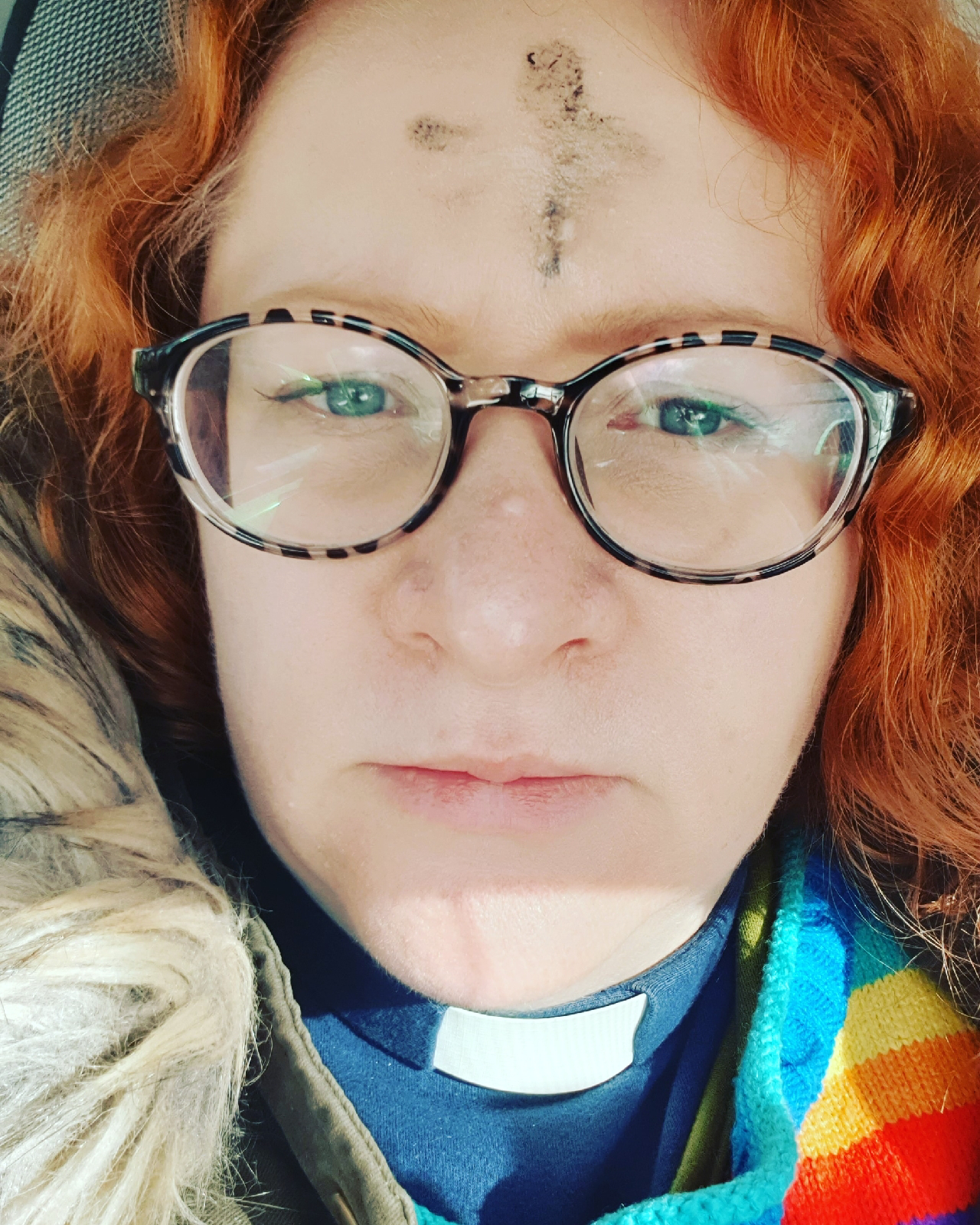
I wrote this for this morning's school service where 90 children came to St Michael's to share in a pared down Ash Wednesday service with ashing. 

I decided to read it again at our main service this evening; we're told to come with the faith of a child and sometimes we need to hear something very simply put.

Ash Wednesday isn’t about thinking of the things we’ve done wrong so we can be reminded that we’re bad people; it’s remembering that God created us from goodness for goodness.

And we get to ask the question why; why, when we’re created good do we sometimes not act kindly, or why do we create space in the world for unkindness to happen?

Today isn’t about thinking that one day we’ll die so that we can be sad; Knowing we will die should help us to see how we should live now.

But we don’t remember our choices and our deaths on our own; we use this day to remember together, as a community, because we don’t live our lives alone, we live our lives together.

And today we apologise together for all those times we chose something that wasn’t loving, that wasn’t kind, and for when we forgot that we aren’t alone; when we forgot that not only do we belong to each other but to God.

Today we recognise together our good and bad choices. We recognise that like God’s wonderful creations the plants and trees we’re capable of amazing beauty if we choose to live lives based in love. Like holy soil nurturing the things which grow in it, we grow in love.

Lent begins today. 40 days and 40 nights to take us up until Easter. 40 days and 40 nights where we think about the best way to live in the world, the best way to use our wonderful gift of a life. 

Let’s just take a moment, a tiny snapshot of time, to stop, to remember and to think of our amazing capacity to love  and to live kind, beautiful, flourishing lives, lives which mirror the love God has for us.


Sunday, 22 July 2018

Mary Magdalene

They Have Taken My Lord Away – Janet Morley

It was unfinished.

We stayed there, fixed, until the end,
women waiting for the body that we loved;
and then it was unfinished.

There was no time to cherish, cleanse, anoint;
no time to handle him with love,
no farewell.

Since then, my hands have waited,
aching to touch even his deadness,
smooth oil into bruises that no longer hurt,
offer his silent flesh my finished act of love.

I came early, as the darkness lifted,
to find the grave ripped open and his body gone;
container of my grief smashed, looted,
leaving my hands still empty.

I turned on the man who came:
"They have taken my Lord - where is his corpse?
Where is the body that is mine to greet?
He is not gone
I am not ready yet, I am not finished -
I cannot let him go I am not whole."

And then he spoke, no corpse,
and breathed,
and offered me my name.
My hands rushed to grasp him;
to hold and hug
and grip his body close;
to give myself again, to cling to him,
and lose myself in love.

"Don't touch me now"

I stopped and waited, my rejected passion
hovering between us like some dying thing.
I, Mary, stood and grieved and then departed.

I have a gospel to proclaim. 


Friday, 30 March 2018

Celtic Lent Day 39

To say Your name before I sleep does not guarantee that in the morning I shall wake in that world which held my bed. Still it matters not, for every world in Yours as I am.
Calvin Miller

Death is like the past. We can't change either of them. We have to make friends with them both.
William Brodrick

I feel like Good Friday is a day which gives us permission to think about death and sadness, anyone who's seen the wonderful Pixar film Inside Out knows sadness is as important as joy. Sadness can help us to grow and change, put our lives in context and help us re-evaluate what's important.
On Good Friday we sit with that, although we know the Easter feast is just about tangible. When we're in the middle of grief or difficult times we don't know when there'll be an end to it. We hope the intensity will become less, which eventually it does.
This day, like Ash Wednesday, also gives us a chance to consider our own mortality. We're here just for a season and because of that need to consider carefully what and who we give our one life to. Good Friday is about love. Choose to give your life to love.

Scripture
I say to God, my rock,
   ‘Why have you forgotten me?
Why must I walk about mournfully
   because the enemy oppresses me?’ 
As with a deadly wound in my body,
   my adversaries taunt me,
while they say to me continually,
   ‘Where is your God?’ 
Psalm 42.9-10

Thursday, 16 March 2017

Day 14

When we speak about celebration we tend rather easily to bring to mind happy, pleasant, gay festivities in which we can forget for a while the hardships of life and immerse ourselves in an atmosphere of music, dance, drinks, laughter, and a lot of cozy small-talk.  But celebration in the Christian sense has very little to do with this.  Celebration is possible only through the deep realization that life and death are never found completely separate.

Celebration can really come about only where fear and love, joy and sorrow, tears and smiles can exist together. Celebration is the acceptance of life in a constantly increasing awareness of its preciousness. And life is precious not only because it can be seen, touched, and tasted, but also because it will be gone one day.

When we celebrate a wedding we celebrate a union as well as a departure; when we celebrate death we celebrate lost friendship as well as gained liberty.  There can be tears after weddings and smiles after funerals.  We can indeed make our sorrows, just as much as our joys, a part of our celebration of life in the deep realization that life and death are not opponents but do, in fact, kiss each other at every moment of our existence.

When we have been able to celebrate life in all these decisive moments where gaining and losing - that is, life and death - touched each other all the time, we will be able to celebrate even our own dying because we have learned from life that those who lose it can find it (Matt. 16:25)

from Creative Ministry by Henri Nouwen

A suggestion for your prayer and meditation:

Consider how life and death have kissed each other in your life.
Is it possible for you to celebrate this experience of gaining and losing?
Hold each of these considerations in mind and offer them to God using this abbreviated prayer written by Henri Nouwen:

Dear Lord, today I thought of the words of Vincent van Gogh: "It is true there is an ebb and flow, but the sea remains the sea". 

You are the sea.

There are days of sadness and days of joy;
there are feelings of guilt and feelings of gratitude;
there are moments of failure and moments of success;
but all of them are embraced by your unwavering love.

O Lord, sea of love and goodness, let me not fear too much the storms and winds of my daily life, and let me know that there is ebb and flow but that the sea remains the sea.  Amen.
Pastor Patty Fox 40 days with 40 Christian mystics

The next few days might have me posting at odd times due to night shifts.

I think one of the most harmful ways we've evolved as a society is by ignoring that we will one day die. Part of Lent is acknowledging our death but also figuring out how we live in the "now", fully embracing this gift we have. Life and death are completely intertwined, I see this clearly in ministry and nursing.

Monday, 13 March 2017

Day 11

In my Father's house are many rooms;
if it were not so,
would I have told you
that I go to prepare a place for you?

(John 14:2)

It seems quite a coincidence that this verse has come up today from Pastor Patty, from the Mystical gospel of John, as it's from a passage so widely used at funerals.
Today we gathered together, a community set apart and bound by grief, to say goodbye to our lovely Revd. Huw's remarkable wife, Nat. I'd only known her since August but found her to be warm, funny, open and just a delight to be around.
We didn't have John 14 today but Philippians 4:
Whatever is true, whatever is honorable, whatever is just, whatever is pure, whatever is pleasing, whatever is commendable, if there is any excellence and if there is anything worthy of praise, think about these things.

By way of a meditation I leave you with the poem which was read at the service:

"God" by Andrew Rudd
God
doesn't have to knock
uses the front door key
doesn't check how clean the house is

knows how to use the kettle
and where the spoons go
washes up

is quite content to sit
and chatter about issues
of no importance

ar just be quiet

Monday, 9 March 2015

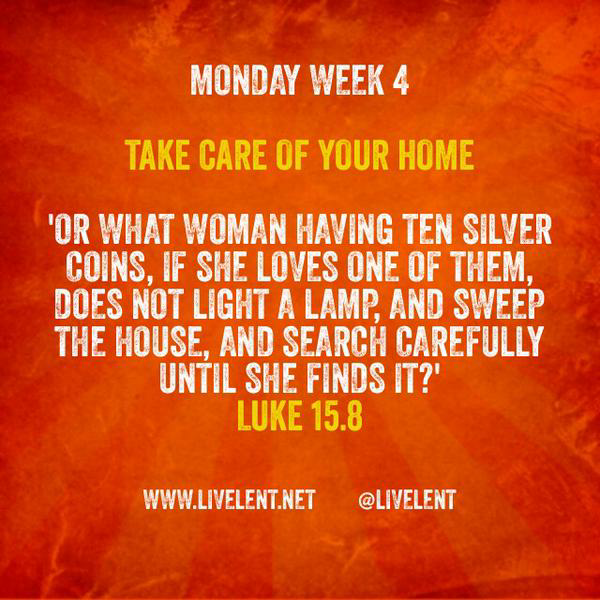
Take Care of Your Home

A really difficult task to accomplish when working a 12 hour shift so my plan for today had been to clean out my locker and ensure our communal work areas remained uncluttered. Sadly the best laid plans often get chucked out of the window, especially you're dealing with acutely unwell patients who can deteriorate so quickly despite all our best efforts.
Today there was order in what might of seemed from the outside chaotic. Today a medical team worked together to preserve life, but sometimes even the best of endeavours are unsuccessful.

Luke 15:8
‘Or what woman having ten silver coins, if she loses one of them, does not light a lamp, sweep the house, and search carefully until she finds it?